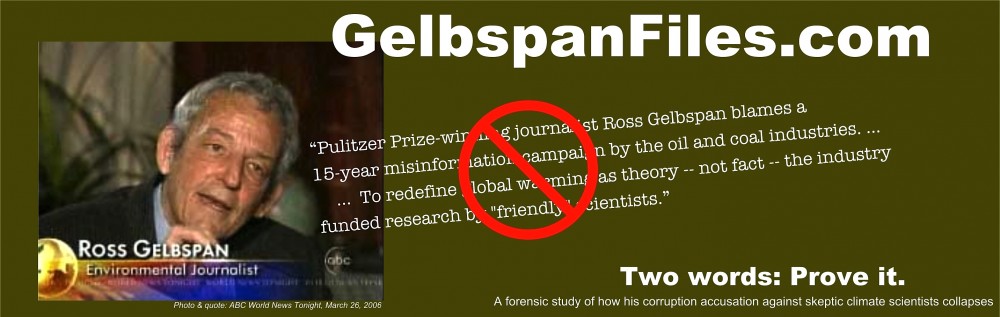
Quite unlikely that I have readers in Rio Linda and Port St Lucie, but in case I do, “raison d’être” means “the most important reason or purpose for someone’s existence.” Speaking personally, my concern is not about what motivates Gelbspan to do what he does, I focus on what he has said and compare it to material which contradicts him, with the basic objective being to ask why these contradictions exist. But it is fair to ask if I’ve encountered narratives where he appears to offer base-level reasons for the actions he has taken. Continue reading
Category Archives: Narrative derailment
Wait. She said What? (Gelbspan may have dug his hole deeper)
It’s bad enough that Columbia Journalism Review article writer Robert S. Eshelman made the mistake of labeling Ross Gelbspan as a Pulitzer winner (which the CJR later deleted initially without explanation) in his May 1, 2014 piece, but when Eshelman dutifully recited an oft-repeated narrative of how Gelbspan dived into an investigation of ‘corrupt funding of skeptic climate scientists’ – the narrative itself being one plagued with highly questionable contradictions – he basically handed Gelbspan a shovel to dig a deeper credibility hole. Continue reading
Five Major Problems in Four Paragraphs, prompting Eight Questions that beg to be Answered
Listen to or read a single version by itself of Ross Gelbspan’s various narratives about what led him to look into the ‘corruption’ of skeptic climate scientists, and it sounds quite compelling. Know some background information on what he’s talking about, and you wonder why he can’t keep his stories straight. Continue reading
Leaving out a Vital Detail about the Western Fuels Association
Ross Gelbspan’s claim about statements in Western Fuels’ annual report – which are not there – is a major problem. His other consistent description about that organization, which leaves out a vital detail, is an additional problem. Continue reading
The National Journal / Greenwire & AZ Republic / Daily Sun Problems
As I’ve said on several occasions here and elsewhere, the major problem with global warming believers’ enslavement to the “reposition global warming as theory rather than fact” phrase is that it is not in any way proof of an arrangement between between skeptics and industry officials involving payments made for false climate assessments. Besides the way it crumbles apart under hard scrutiny, other associated narratives tied to it fall apart the same way. Such as this one, Continue reading
Timeline History and Inconvenient Truths of Ross Gelbspan’s and Al Gore’s “reposition global warming” Phrase
The idea of man-caused global warming is especially effective because it can be pounded into practically everybody’s head via three easily memorized talking points. Global warming believers need only to counter dry recitations of skeptic science material with:
- assertions that the sheer numbers of ‘climate scientists’ on the IPCC side indicates this to be the overwhelming consensus opinion
- claims about leaked memo evidence proving skeptics are paid industry money to “reposition global warming as theory rather than fact” – dupe the public, in other words
- the obvious conclusion that reporters aren’t obligated to give fair balance to skeptics because of the previous two points.
In a nutshell, settled science, crooked skeptics, reporters may ignore skeptics — bam, bam, bam.
A timeline of where, how and when that “reposition global warming” phrase first appeared and where it prominently pops up afterward is something global warming believers would hate, since it might prompt a total loss of faith in the validity of that central accusation point. The loss could cascade into questions of whether the science actually is settled in the face of skeptics’ science-based criticisms, and people may also start to wonder about the ‘fair media balance’ idea, since they might not readily recall instances where skeptics actually received that from mainstream media reporters. Continue reading
Pulitzer Label Problem? Journalists Will Fix that For You. Pt II: Bud Ward
Honestly, when I said in my previous post that one of the founders of Society of Environmental Journalists’ (SEJ) walked back Ross Gelbspan’s “Pulitzer-winner” label at the same time the SEJ itself was calling Gelbspan a “Pulitzer-winner”, I gave SEJ co-founder Bud Ward too much credit. If anything, Ward inadvertently dug a bigger hole for Gelbspan by dancing around the application of the label. Continue reading
Greenpeace Loves Ross Gelbspan, Pt 2. Funny How They Don’t Mention his Name Early On
In Al Gore’s NY Times review of Gelbspan’s 2004 “Boiling Point” book, he said “Gelbspan’s first book, ‘The Heat Is On’ (1997), remains the best, and virtually only, study of how the coal and oil industry has provided financing to a small group of contrarian scientists“. The executive director of Greenpeace said in 2009 that Gelbspan was a ‘lone voice‘ who uncovered the corrupt influences of the fossil fuel industry. But in a 1996 midyear summary of their accomplishments, Greenpeace International claimed this particular accolade for themselves….. without a solitary mention of Gelbspan. Continue reading
The ‘television editor told me “We did. Once.”’ Problem
My 11/8 blog piece recapped six problems seen with a single paragraph written by Ross Gelbspan in a 2005 Mother Jones article, and went on to tell about another of his major narrative derailments. But I mentioned there was one more big problem that needed a separate blog piece to examine it. That’s what this piece will cover. Continue reading
‘Industry PR Campaign sways US Opinion’; except practically nobody saw it
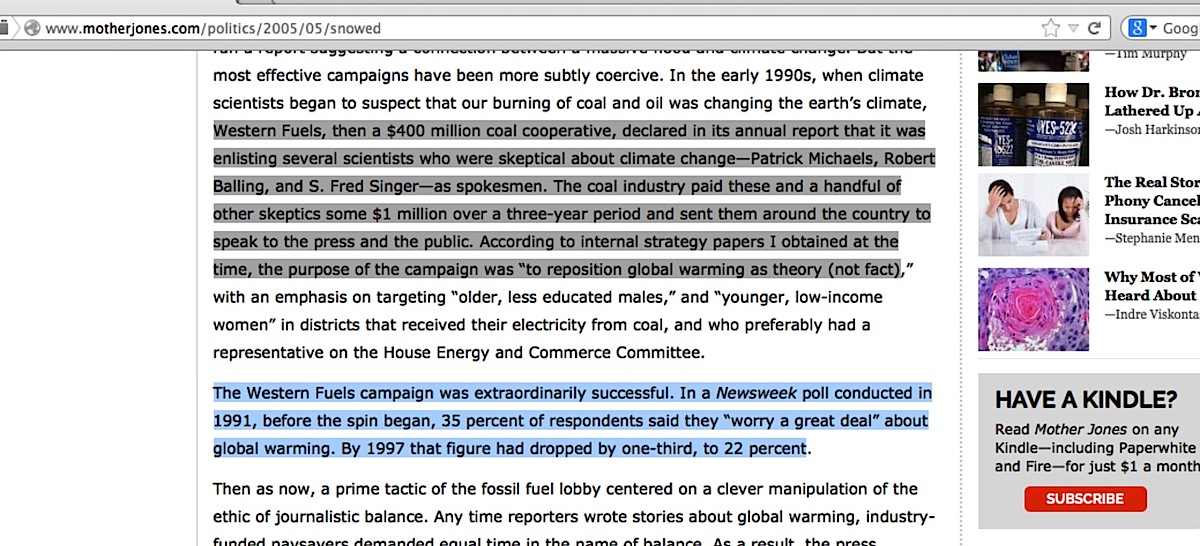
Ross Gelbspan’s “Snowed” article in the May/June 2005 issue of Mother Jones magazine described how a ‘misguided application of journalistic balance’ and ‘a decade-long campaign of deception, disinformation, and, at times, intimidation by the fossil fuel lobby’ was causing the media not to properly warn us about the perils of global warming. Accept his narrative without question, and it’s a rallying cry to solve the problem. But notice the errors in his article’s 5th & 6th paragraphs, and it makes you wonder how much more he gets wrong.