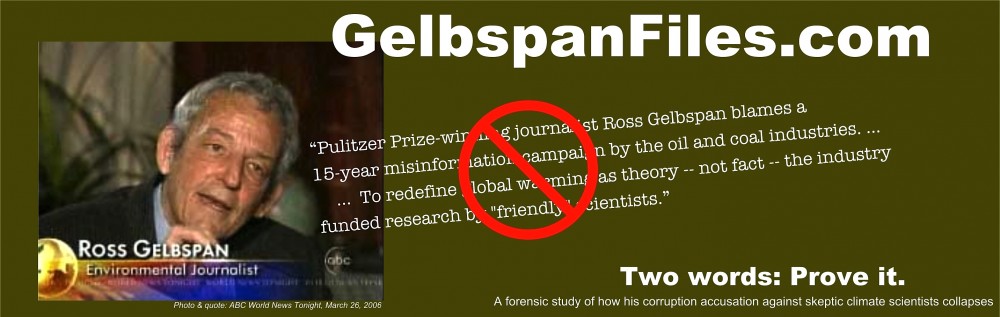
This particular situation illustrates how the climate science issue is way bigger than the science. We do indeed have a crisis happening, but it doesn’t concern the climate. It’s a crisis involving the legacy news media’s journalism malfeasance, which includes the now defunded PBS NewsHour (… and there’s a rather direct tie-in to what I do right here at this GelbspanFiles blog).
In my formative learning years in high school and college, those were the days when the PBS NewsHour was still fair and balanced in its news reporting and followup in-depth news analysis of major issues at the time – they gave their viewers insight about the U.S. and Soviet sides of international relations during the Reagan era, while regularly having Israeli / Arab discussions featuring Hisham Melhem and David Makovsky. Discussions of domestic U.S. political matters always featured a Democrat and a Republican elected official paired against each other.
It was that particular balance, endorsed by no less than the original founders, however, which caused me to begin wondering minimally by the late 1990s why the program never featured any scientists from the skeptic side of the global warming issue. In my 2010 piece for American Thinker on the manner in which the NewsHour seemed to regurgitate words from the namesake of my blog, Ross Gelbspan, I didn’t idly repeat my claim without support about the exclusion of such skeptics, I quantified it. I’m still doing that.
If the NewsHour didn’t exclude in-studio appearances by skeptic scientists / expert skeptic speakers, items such as these from the NewsHour hosts would get shot down immediately in front of a national viewing audience:
NewsHour reporter Blair Waltman-Alexin [Austin PBS], Sep 30, 2023: … Austin saw record breaking heat, but some areas of the city see hotter temperatures than others … So the city of Austin teamed up with researchers at the University of Texas to see exactly what was going on. What they found was higher temperatures in places with less greenery. This is called the urban heat island effects …
Dr. Dev Niyogi [Geosciences and Engineering prof at the U of Texas, Austin]: .. when you measure the temperatures, you will get that there are blobs, which are much hotter, it will look like an island. And that’s why it gets referred to as an urban heat island. …
Blair Waltman-Alexin: Some of this can be traced back to redlining practices that started in the 1930s when the federal government labeled non-white neighborhoods as risky places to invest home loans. According to the Environmental Protection Agency, research shows that red line communities have less vegetative cover, higher temperatures, and increased health risks.
————————————————-
NewsHour host William Brangham, July 27, 2023: In addition to the dangers faced by where someone works, sometimes, where you live can also make the impacts of extreme heat worse, like living in certain parts of a city. That’s because of a phenomenon called the urban heat island effect. A recent report by the research group Climate Central showed that more than 40 million Americans live in these hot spots. .. we turn to Michael Mendez. He’s assistant professor of environmental planning and policy at the University of California, Irvine .. what is the urban heat island effect?
Michael Mendez: … 40 percent of residents in the United States are under a heat advisory. And many of them are living in urban areas that don’t have adequate infrastructure, let alone environmental amenities like trees and other forms of greenery that provide shade. So, an urban heat island effect is where you have a lot of urbanized and suburban areas that are paved over with asphalt, concrete, other — other types of building materials that absorb the heat. And with little vegetation and trees for shade, and other types of cooling material, these areas and communities could be anywhere between five and even 20 degrees hotter than other neighborhoods that have more green space for shade. … So imagine not just a schoolyard, which is just, unfortunately, an urban heat island, but an entire neighborhood …
William Brangham: .. I also understand that it is not equally spread across demographics, that certain people are more vulnerable than others. Can you explain?
Michael Mendez: … It does not affect everyone equally … political choices have been made over the decades, if not centuries, that have withheld vital resources and infrastructure from communities, primarily low income-communities of color, African American and Latino communities. .. they’re the least prepared and often suffered the most impacts, because they don’t have — they have crumbling infrastructure, and they don’t have the amenities that will protect them and make them more resilient from our changing and extreme climate.
————————————————-
PBS host John Yang, Dec 12, 2019: … Louisville is one of the nation’s fastest-warming urban heat islands. Parts of the city can be 10 degrees hotter than surrounding areas. Green Heart researchers think more trees could be a solution. They can improve air quality, cool neighborhoods, help combat global warming … In Louisville, as in so many cities, tree canopy coverage is a matter of rich and poor. The view from above tells the story. Wealthier areas, like this East Side neighborhood, have up to twice as many trees as poorer areas in the South and West, which have histories of discriminatory housing practices.
Offer just those three examples to people on the street who are otherwise completely disinterested in the climate issue and they will say the overall narrative sounds plausible – isolated islands of heat in urban areas resulting from unfair racism circumstances. Offer those three examples to anyone on the skeptic side who’s fully knowledgeable about all aspects of the issue, and they might have to refrain from using expletives to describe how blatantly false those narratives are.
Most of the land mass of the Earth is rural – farmland, forests, prairies, mountains, dusty deserts. Little towns, cities, huge metro areas are islands of heat surrounded by cooler rural areas.
Period. It is just that simple. Nobody needs to be a climate scientist or even a rocket scientist to understand that rock bottom concept. If any reporter had never heard of it, mere minutes worth of searching would lead to the explanation all of us on this side know.
This kind of reporting is inexcusable. But so is:
• giving credence to the idea that science conclusions are validated by a show of hands – science has never worked that way.
• not telling there was no way the fossil fuel industry could’ve known about the harm of man-caused global warming back in the 1970s when journalists back then were reporting about the harm of global cooling.
• never verifying if one of their own, former Boston Globe reporter Ross Gelbspan ever actually won a Pulitzer Prize – it would be pure career-ending ‘stolen journalism valor’ if he did not.
• never verifying if one of the four accusation elements about “industry-orchestrated disinformation campaigns” have any merit at all.
Skeptic climate scientists exist, they say there is no climate crisis, as do other expert speakers on the topic. That is an irrefutable fact, and all of these people are fully capable of disputing the wall of assertions – science and politically accusatory – for hours on end. The public is simply not told about that side of the issue; they are instead fed endless kinds of outright disinformation from the legacy news media.
I’ve said it before, I’ll say it again: if we’d had a responsible, objective news media as far back as the late 1990s who’d know what a rat story was if they smelled it, then it is quite probably we would not even be discussing the ‘climate crisis’ in any form today.
The climate issue is hardly more than a window into the world of how outright journalism malfeasance across the board on myriad controversial political issues is the real crisis the public is facing.